 Add to Chrome
 Add to Firefox
 Add to Edge
GPU Forecasters: Language Models as Selective Surrogates for Kernel Runtime Optimization
May 29, 2026
GPU kernels are the workhorse of modern deep learning, and optimizing them (via evolutionary search or coding agents) usually requires repeated measurement on target hardware. While these measurements provide the ground-truth signal necessary for kernel search, they are costly, because each evaluation of a kernel requires compilation and repeated execution on a GPU. As improvements in LLM inference reduce the cost of writing novel kernels and LLM-driven searches scale to large search budgets, on-device evaluation becomes a bottleneck. To address this, we study how LLMs can serve as selective GPU surrogates for kernel evaluation, by forecasting the performance of proposed kernels. A useful surrogate should be accurate, and it should be selective, by knowing when it could be wrong, and deferring to the GPU. To evaluate surrogates, we measure whether their forecasts are accurate, calibrated, and practically useful for recovering fast kernels under limited GPU-measurement budgets. Next, we study whether reinforcement learning can improve forecast accuracy and confidence calibration. Our experiments demonstrate that LLMs can accurately forecast relative kernel performance, that their utility can be improved through reinforcement learning. Used inside a kernel search, the surrogate lets the search consider several times as many candidates under the same GPU evaluation budget, and that leads to finding faster kernels than an equal-budget baseline. These results suggest that LLMs can play a broader role in kernel optimization, by acting as virtual models of a GPU rather than solely as kernel generators for search.

PhyMotion: Structured 3D Motion Reward for Physics-Grounded Human Video Generation
May 14, 2026Generating realistic human motion is a central yet unsolved challenge in video generation. While reinforcement learning (RL)-based post-training has driven recent gains in general video quality, extending it to human motion remains bottlenecked by a reward signal that cannot reliably score motion realism. Existing video rewards primarily rely on 2D perceptual signals, without explicitly modeling the 3D body state, contact, and dynamics underlying articulated human motion, and often assign high scores to videos with floating bodies or physically implausible movements. To address this, we propose PhyMotion, a structured, fine-grained motion reward that grounds recovered 3D human trajectories in a physics simulator and evaluates motion quality along multiple dimensions of physical feasibility. Concretely, we recover SMPL body meshes from generated videos, retarget them onto a humanoid in the MuJoCo physics simulator, and evaluate the resulting motion along three axes: kinematic plausibility, contact and balance consistency, and dynamic feasibility. Each component provides a continuous and interpretable signal tied to a specific aspect of motion quality, allowing the reward to capture which aspects of motion are physically correct or violated. Experiments show that PhyMotion achieves stronger correlation with human judgments than existing reward formulations. These gains carry over to RL-based post-training, where optimizing PhyMotion leads to larger and more consistent improvements than optimizing existing rewards, improving motion realism across both autoregressive and bidirectional video generators under both automatic metrics and blind human evaluation (+68 Elo gain). Ablations show that the three axes provide complementary supervision signals, while the reward preserves overall video generation quality with only modest training overhead.
MolmoAct2: Action Reasoning Models for Real-world Deployment
May 04, 2026Vision-Language-Action (VLA) models aim to provide a single generalist controller for robots, but today's systems fall short on the criteria that matter for real-world deployment. Frontier models are closed, open-weight alternatives are tied to expensive hardware, reasoning-augmented policies pay prohibitive latency for their grounding, and fine-tuned success rates remain below the threshold for dependable use. We present MolmoAct2, a fully open action reasoning model built for practical deployment, advancing its predecessor along five axes. We introduce MolmoER, a VLM backbone specialized for spatial and embodied reasoning, trained on a 3.3M-sample corpus with a specialize-then-rehearse recipe. We release three new datasets spanning low-to-medium cost platforms, including MolmoAct2-BimanualYAM, 720 hours of teleoperated bimanual trajectories that constitute the largest open bimanual dataset to date, together with quality-filtered Franka (DROID) and SO100/101 subsets. We provide OpenFAST, an open-weight, open-data action tokenizer trained on millions of trajectories across five embodiments. We redesign the architecture to graft a flow-matching continuous-action expert onto a discrete-token VLM via per-layer KV-cache conditioning. Finally, we propose MolmoThink, an adaptive-depth reasoning variant that re-predicts depth tokens only for scene regions that change between timesteps, retaining geometric grounding at a fraction of prior latency. In the most extensive empirical study of any open VLA to date, spanning 7 simulation and real-world benchmarks, MolmoAct2 outperforms strong baselines including Pi-05, while MolmoER surpasses GPT-5 and Gemini Robotics ER-1.5 across 13 embodied-reasoning benchmarks. We release model weights, training code, and complete training data. Project page: https://allenai.org/blog/molmoact2
WildDet3D: Scaling Promptable 3D Detection in the Wild
Apr 09, 2026Understanding objects in 3D from a single image is a cornerstone of spatial intelligence. A key step toward this goal is monocular 3D object detection--recovering the extent, location, and orientation of objects from an input RGB image. To be practical in the open world, such a detector must generalize beyond closed-set categories, support diverse prompt modalities, and leverage geometric cues when available. Progress is hampered by two bottlenecks: existing methods are designed for a single prompt type and lack a mechanism to incorporate additional geometric cues, and current 3D datasets cover only narrow categories in controlled environments, limiting open-world transfer. In this work we address both gaps. First, we introduce WildDet3D, a unified geometry-aware architecture that natively accepts text, point, and box prompts and can incorporate auxiliary depth signals at inference time. Second, we present WildDet3D-Data, the largest open 3D detection dataset to date, constructed by generating candidate 3D boxes from existing 2D annotations and retaining only human-verified ones, yielding over 1M images across 13.5K categories in diverse real-world scenes. WildDet3D establishes a new state-of-the-art across multiple benchmarks and settings. In the open-world setting, it achieves 22.6/24.8 AP3D on our newly introduced WildDet3D-Bench with text and box prompts. On Omni3D, it reaches 34.2/36.4 AP3D with text and box prompts, respectively. In zero-shot evaluation, it achieves 40.3/48.9 ODS on Argoverse 2 and ScanNet. Notably, incorporating depth cues at inference time yields substantial additional gains (+20.7 AP on average across settings).
VFIG: Vectorizing Complex Figures in SVG with Vision-Language Models
Mar 25, 2026Scalable Vector Graphics (SVG) are an essential format for technical illustration and digital design, offering precise resolution independence and flexible semantic editability. In practice, however, original vector source files are frequently lost or inaccessible, leaving only "flat" rasterized versions (e.g., PNG or JPEG) that are difficult to modify or scale. Manually reconstructing these figures is a prohibitively labor-intensive process, requiring specialized expertise to recover the original geometric intent. To bridge this gap, we propose VFIG, a family of Vision-Language Models trained for complex and high-fidelity figure-to-SVG conversion. While this task is inherently data-driven, existing datasets are typically small-scale and lack the complexity of professional diagrams. We address this by introducing VFIG-DATA, a large-scale dataset of 66K high-quality figure-SVG pairs, curated from a diverse mix of real-world paper figures and procedurally generated diagrams. Recognizing that SVGs are composed of recurring primitives and hierarchical local structures, we introduce a coarse-to-fine training curriculum that begins with supervised fine-tuning (SFT) to learn atomic primitives and transitions to reinforcement learning (RL) refinement to optimize global diagram fidelity, layout consistency, and topological edge cases. Finally, we introduce VFIG-BENCH, a comprehensive evaluation suite with novel metrics designed to measure the structural integrity of complex figures. VFIG achieves state-of-the-art performance among open-source models and performs on par with GPT-5.2, achieving a VLM-Judge score of 0.829 on VFIG-BENCH.
V-Co: A Closer Look at Visual Representation Alignment via Co-Denoising
Mar 17, 2026Pixel-space diffusion has recently re-emerged as a strong alternative to latent diffusion, enabling high-quality generation without pretrained autoencoders. However, standard pixel-space diffusion models receive relatively weak semantic supervision and are not explicitly designed to capture high-level visual structure. Recent representation-alignment methods (e.g., REPA) suggest that pretrained visual features can substantially improve diffusion training, and visual co-denoising has emerged as a promising direction for incorporating such features into the generative process. However, existing co-denoising approaches often entangle multiple design choices, making it unclear which design choices are truly essential. Therefore, we present V-Co, a systematic study of visual co-denoising in a unified JiT-based framework. This controlled setting allows us to isolate the ingredients that make visual co-denoising effective. Our study reveals four key ingredients for effective visual co-denoising. First, preserving feature-specific computation while enabling flexible cross-stream interaction motivates a fully dual-stream architecture. Second, effective classifier-free guidance (CFG) requires a structurally defined unconditional prediction. Third, stronger semantic supervision is best provided by a perceptual-drifting hybrid loss. Fourth, stable co-denoising further requires proper cross-stream calibration, which we realize through RMS-based feature rescaling. Together, these findings yield a simple recipe for visual co-denoising. Experiments on ImageNet-256 show that, at comparable model sizes, V-Co outperforms the underlying pixel-space diffusion baseline and strong prior pixel-diffusion methods while using fewer training epochs, offering practical guidance for future representation-aligned generative models.
InfinityStory: Unlimited Video Generation with World Consistency and Character-Aware Shot Transitions
Mar 04, 2026Generating long-form storytelling videos with consistent visual narratives remains a significant challenge in video synthesis. We present a novel framework, dataset, and a model that address three critical limitations: background consistency across shots, seamless multi-subject shot-to-shot transitions, and scalability to hour-long narratives. Our approach introduces a background-consistent generation pipeline that maintains visual coherence across scenes while preserving character identity and spatial relationships. We further propose a transition-aware video synthesis module that generates smooth shot transitions for complex scenarios involving multiple subjects entering or exiting frames, going beyond the single-subject limitations of prior work. To support this, we contribute with a synthetic dataset of 10,000 multi-subject transition sequences covering underrepresented dynamic scene compositions. On VBench, InfinityStory achieves the highest Background Consistency (88.94), highest Subject Consistency (82.11), and the best overall average rank (2.80), showing improved stability, smoother transitions, and better temporal coherence.
AnchorWeave: World-Consistent Video Generation with Retrieved Local Spatial Memories
Feb 16, 2026Maintaining spatial world consistency over long horizons remains a central challenge for camera-controllable video generation. Existing memory-based approaches often condition generation on globally reconstructed 3D scenes by rendering anchor videos from the reconstructed geometry in the history. However, reconstructing a global 3D scene from multiple views inevitably introduces cross-view misalignment, as pose and depth estimation errors cause the same surfaces to be reconstructed at slightly different 3D locations across views. When fused, these inconsistencies accumulate into noisy geometry that contaminates the conditioning signals and degrades generation quality. We introduce AnchorWeave, a memory-augmented video generation framework that replaces a single misaligned global memory with multiple clean local geometric memories and learns to reconcile their cross-view inconsistencies. To this end, AnchorWeave performs coverage-driven local memory retrieval aligned with the target trajectory and integrates the selected local memories through a multi-anchor weaving controller during generation. Extensive experiments demonstrate that AnchorWeave significantly improves long-term scene consistency while maintaining strong visual quality, with ablation and analysis studies further validating the effectiveness of local geometric conditioning, multi-anchor control, and coverage-driven retrieval.
A Survey on Long-Video Storytelling Generation: Architectures, Consistency, and Cinematic Quality
Jul 09, 2025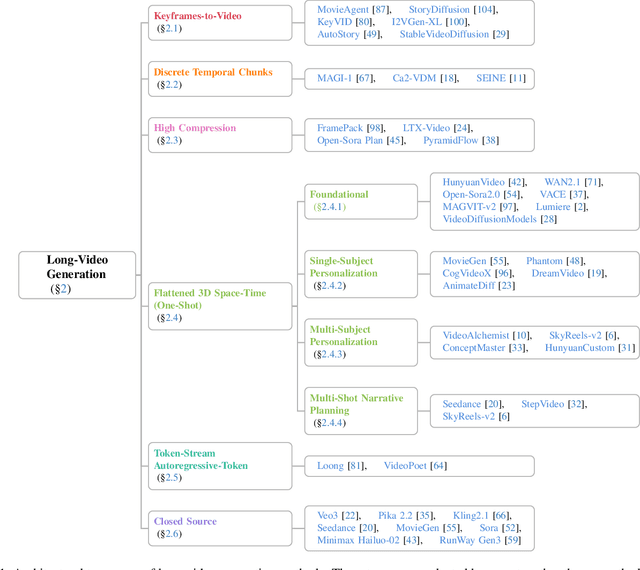
Despite the significant progress that has been made in video generative models, existing state-of-the-art methods can only produce videos lasting 5-16 seconds, often labeled "long-form videos". Furthermore, videos exceeding 16 seconds struggle to maintain consistent character appearances and scene layouts throughout the narrative. In particular, multi-subject long videos still fail to preserve character consistency and motion coherence. While some methods can generate videos up to 150 seconds long, they often suffer from frame redundancy and low temporal diversity. Recent work has attempted to produce long-form videos featuring multiple characters, narrative coherence, and high-fidelity detail. We comprehensively studied 32 papers on video generation to identify key architectural components and training strategies that consistently yield these qualities. We also construct a comprehensive novel taxonomy of existing methods and present comparative tables that categorize papers by their architectural designs and performance characteristics.
CLaMR: Contextualized Late-Interaction for Multimodal Content Retrieval
Jun 06, 2025Online video web content is richly multimodal: a single video blends vision, speech, ambient audio, and on-screen text. Retrieval systems typically treat these modalities as independent retrieval sources, which can lead to noisy and subpar retrieval. We explore multimodal video content retrieval, where relevance can be scored from one particular modality or jointly across multiple modalities simultaneously. Consequently, an effective retriever must dynamically choose which modality (or set of modalities) best addresses the query. We introduce CLaMR, a multimodal, late-interaction retriever that jointly indexes 4 modalities: video frames, transcribed speech, on-screen text, and metadata. CLaMR jointly encodes all modalities with a unified multimodal backbone for improved contextualization and is trained to enhance dynamic modality selection via two key innovations. First, given the lack of training data for multimodal retrieval, we introduce MultiVENT 2.0++, a large-scale synthetic training dataset built on MultiVENT 2.0 (event-centric videos in various languages paired with queries) with modality-targeted queries. Next, we propose a modality-aware loss that jointly trains according to a standard contrastive objective alongside an objective for learning correct modality usage. On the test sets of MultiVENT 2.0++ and MSRVTT, conventional aggregation strategies, such as averaging similarities for baseline retrievers, degrade performance by introducing noise from irrelevant modalities. In contrast, CLaMR consistently outperforms existing retrievers: on MultiVENT 2.0++, CLaMR improves nDCG@10 by 25.6 over the best single-modality retriever and by 35.4 over the best multi-modality retriever. We illustrate CLaMR's downstream utility on long-video QA, retrieving relevant frames and obtaining a 3.50% boost over LanguageBind on Video-MME and 1.42% over dense sampling on LongVideoBench.